.png?width=657&height=57&name=OXFORD%20LOGO%20(1).png "OXFORD LOGO (1)")


In the first two articles in this series, we looked at what it really takes to set a launch up for success. We reframed launch as a continuum that starts in Phase II, not a project that begins in Phase III, and we showed why not every asset should be pushed through the same heavy global launch playbook. Those pieces matter. But even when they are in place, many organisations still see a stubborn gap between the launches they planned and the launches they actually get.
That gap shows up as value leakage across markets. On paper, the global strategy is clear and the framework is strong. In practice, too much launch value is lost as plans move from Global to Regions to Affiliates and into very different country realities. Local teams might rewrite large sections of the plan, timelines slip at the interfaces, and early performance is patchy even when the science and customer needs are strong.
This article explores how to reduce that value leakage by optimising global–local ways of working for launch.
-
We start with the hand-offs model, where Global develops a comprehensive plan and passes it down the line, and unpack why it so often fails in practice.
-
We then contrast this with a genuinely integrated approach, built around one shared launch plan that Global, Regions and Affiliates shape and own together.
-
Finally, we look at how teams actually work and lead in this model – the roles, decision rights and behaviours that make integration real – and how a simple launch manifesto can capture those choices in a way everyone can act on.
The hand-offs model: why it looks good on paper but under‑delivers in practice
Many pharma leaders know this pattern. Global has poured months into a detailed launch plan and Regions and Affiliates are aligned in principle. The slide deck looks impressive and there has been many meetings to bring people on board with the global strategy.
On the surface, the hand-offs approach can look efficient. Global defines the overall strategy, Regions translate and refine whilst affiliates focus on execution. Of course, everyone wants Global, Regions and Affiliates to pull in the same direction, but the challenge is in the how glo-cal alignment is created.
Too often with the hand-offs approach, it starts with a very lengthy Global launch plan handed over as the template for everyone else to read. By the time that plan reaches local teams, context has been stripped away, assumptions have been compressed and key strategic decisions that were debated in the room, become short bullet points on a slide.
In reality, important detail is lost every time the work is passed on. As strategy moves from Global to Regions to Affiliates:
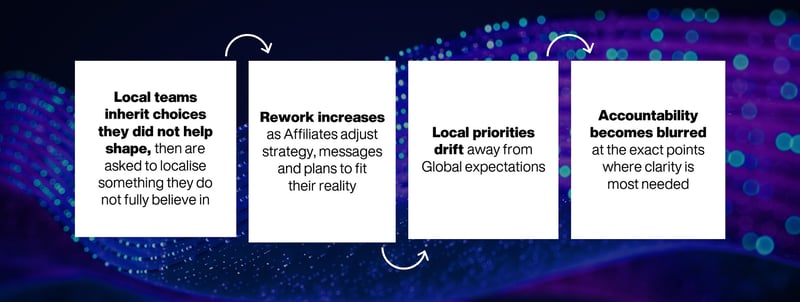
Over time, this becomes a structural reason why launches under perform across markets: leaders feel the launch slowing down at the interfaces where work should pass from Global to Regions to Affiliates, timelines slip while teams seek clarification, the plan fragments and energy drops.
The hand-offs approach creates friction,
integrated planning creates momentum
Over time, the hand-offs model becomes a structural reason why launches under perform across markets: leaders feel the launch slowing at the interfaces where work should pass from Global to Regions to Affiliates, timelines slip while teams seek clarification, the plan fragments and energy drops. The answer is not more pages in the plan, but a different way of organising ownership and decisions so launch is planned and run as one effort with many owners, not a sequence of hand offs.
A genuinely integrated approach – one plan, one lead, shared ownership and accountability
If the hand-offs model explains why launches can stall at the interfaces, the integrated model is about designing one launch that Global, Regions and Affiliates genuinely own together.
At its core, an integrated approach means one plan, co created early across functions and markets. Global still sets the direction, but Regions and Affiliates help shape how that direction turns into strategy, evidence, access and execution in real markets, from the start rather than at the end.
In practice, this starts with a single, focused Global launch plan that is built with Region and Affiliate input, not simply handed to them. That plan becomes the shared spine everyone works from, rather than a 200 page document each market quietly rewrites.
Around that spine, the integrated model has three essentials roles:
When these roles are in place, the benefits are concrete. Decisions are faster, local fit and ownership are stronger, launch readiness improves, all of this because the people doing the work really own the plan.
Finally, an integrated approach recognises that one plan still has to work in many market realities. Structural differences in access, uptake speed, HCP engagement and care pathway maturity mean that treating all markets the same is another way good launches fall short.
That is why we use country archetypes: grouping markets by the characteristics that really drive launch behaviour, and flexing the integrated plan by archetype rather than by guesswork or politics. Global can give clear strategic direction for each archetype; Affiliates see themselves in a framework that matches their reality. Co creation gets faster, localisation gets easier, and the plan remains coherent across markets.
How teams work and lead, and the role of a launch manifesto
The model only works if everyone knows how to work together. An integrated setup only delivers if people behave differently. The structure creates the conditions; day to day leadership and habits turn it into better launch performance.
Decision rights should be explicit, each person knows what they own, what they influence and what must be escalated. Core launch meetings are designed around decisions, not status updates. The standing question is: what are we deciding today, and who owns that decision? Escalations to the Steering Committee should be used sparingly, and only where there is a genuine trade off the core team cannot resolve.
There is also an agreed cadence of core team reviews and steering meetings, plus clear milestone gates for readiness, launch and post launch management.
Shying away from perfection is critically important. Teams treat the integrated launch plan as directional and always on. They aim to get it 80% right, then refine it as data, label, access and competitor moves come through. That mindset makes it easier for Global, Regions and Affiliates to talk openly about what is and isn’t working in markets, without feeling they are breaking the plan every time they adjust.
A launch manifesto is a simple, practical way to lock these global-local ways of working in. A short kick off session to co create a cross functional launch manifesto is often a turning point. The manifesto is a one page internal commitment that spells out:
-
What this launch will stand for – for patients, HCPs, systems and the company
-
What great will look like in concrete terms
-
How Global, Regions and Affiliates will work together to deliver it – the non negotiables in how decisions are made, how issues are raised and how hand offs will work
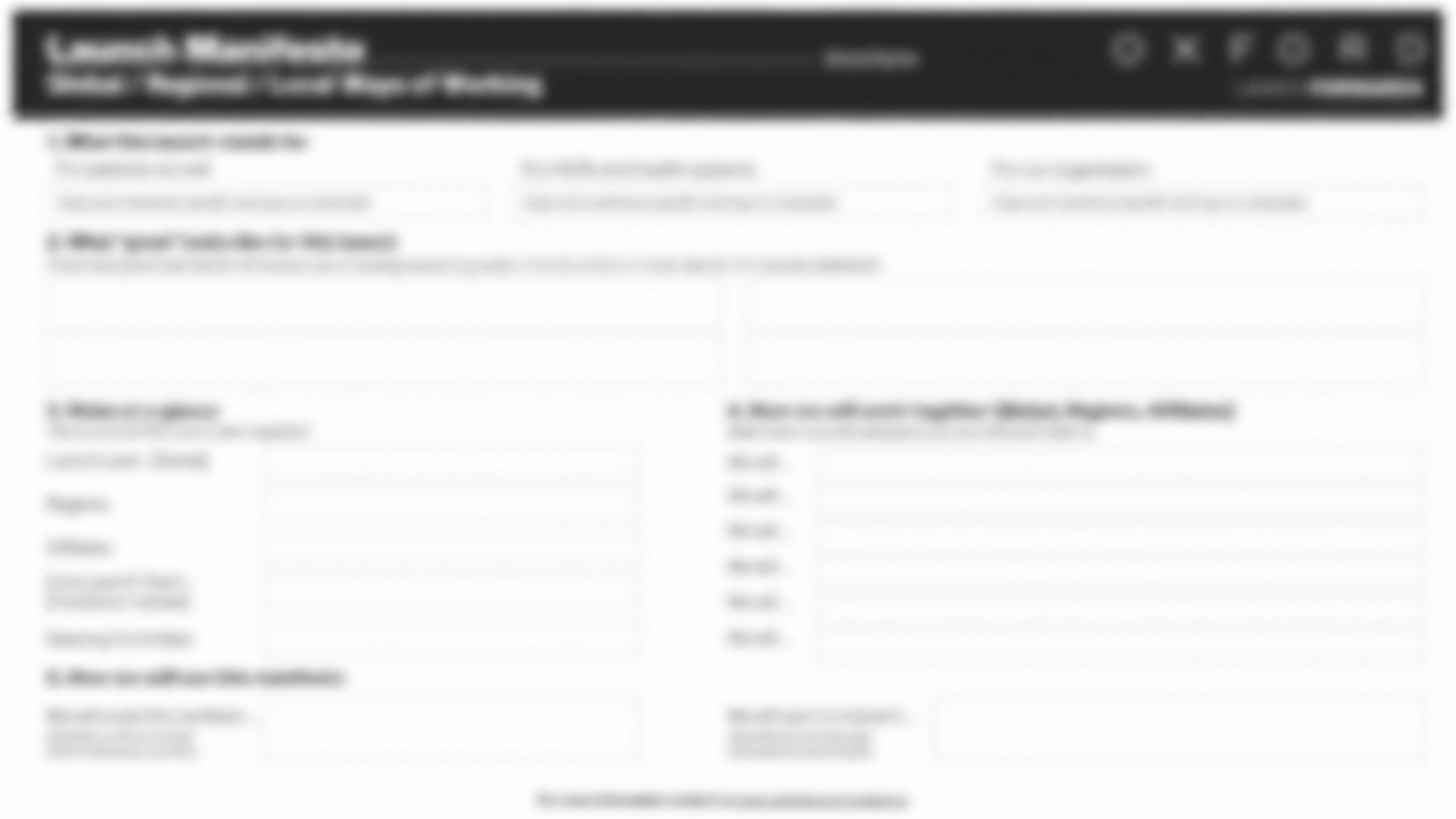
Because it is created by the people who will run the launch, in their own words, it sets the tone for the launch team, becoming the foundation for the Global launch plan and priorities.
When global and local teams move from hand offs to one shared integrated plan, the gap between strategy and execution closes and launches start to perform closer to their true potential across markets. In a world where launch success is still the exception, optimising global–local ways of working is no longer a nice to have, it is one of the few levers that directly tackles value lost between the plan and what happens in real markets.
Read the rest of our launch series here:
.png?width=1200&height=627&name=Scenario%20Planning%20(2).png)
Can we help you?
Delphine leads our Life Sciences team, reach out to her to talk about creating a launch plan that sticks.

Share this

In self-pay markets, focus on what really moves patients

When does launch really start?


No Comments Yet
Let us know what you think