.png?width=657&height=57&name=OXFORD%20LOGO%20(1).png "OXFORD LOGO (1)")


How to move from a rigid global playbook to a tailored launch plan
Over recent years launch expectations have become more demanding in many ways, with the need to provide enough evidence at launch, access planning and quality stakeholder engagement to start fast and sustain growth over time. Global frameworks are often applied in almost the same way regardless of the type of launch. The pressure on the cross-functional teams becomes obvious and the commercial impact can become difficult to see.
The core business question is this: with finite cross-functional resources, how do you assess when to lean into the full-on global launch framework and when to run a much lighter, more focused launch?
In our work in Life Sciences, we see that the teams who answer this well do two things differently:
First, they are explicit about launch types, they distinguish between a small number of clear archetypes instead of treating launch as a single category.
Second, they use one shared framework that flexes by archetype, so that evidence generation, access strategy, market development, customer engagement, and capability building are consciously dialled up or down based on the true opportunity and risk of each asset.
Not all launches are equal, so a single launch playbook won’t work. You need a common framework that flexes by launch type, so focus, effort and finite resources match the real opportunity and patient impact
From launch type to resourcing choices
Recognising your launch archetype only adds value if it guides concrete trade-offs in your evidence generation, access strategy, promotional mix, and capability building. You must link "launch readiness" to true "launch impact" by focusing only on what matters most for that specific launch type:
To turn four launch types into something your teams can actually work with, it helps to see how resourcing flexes across the core pillars.
Download the example Resourcing choices per launch type table to see where to dial investment up or down for each archetype.
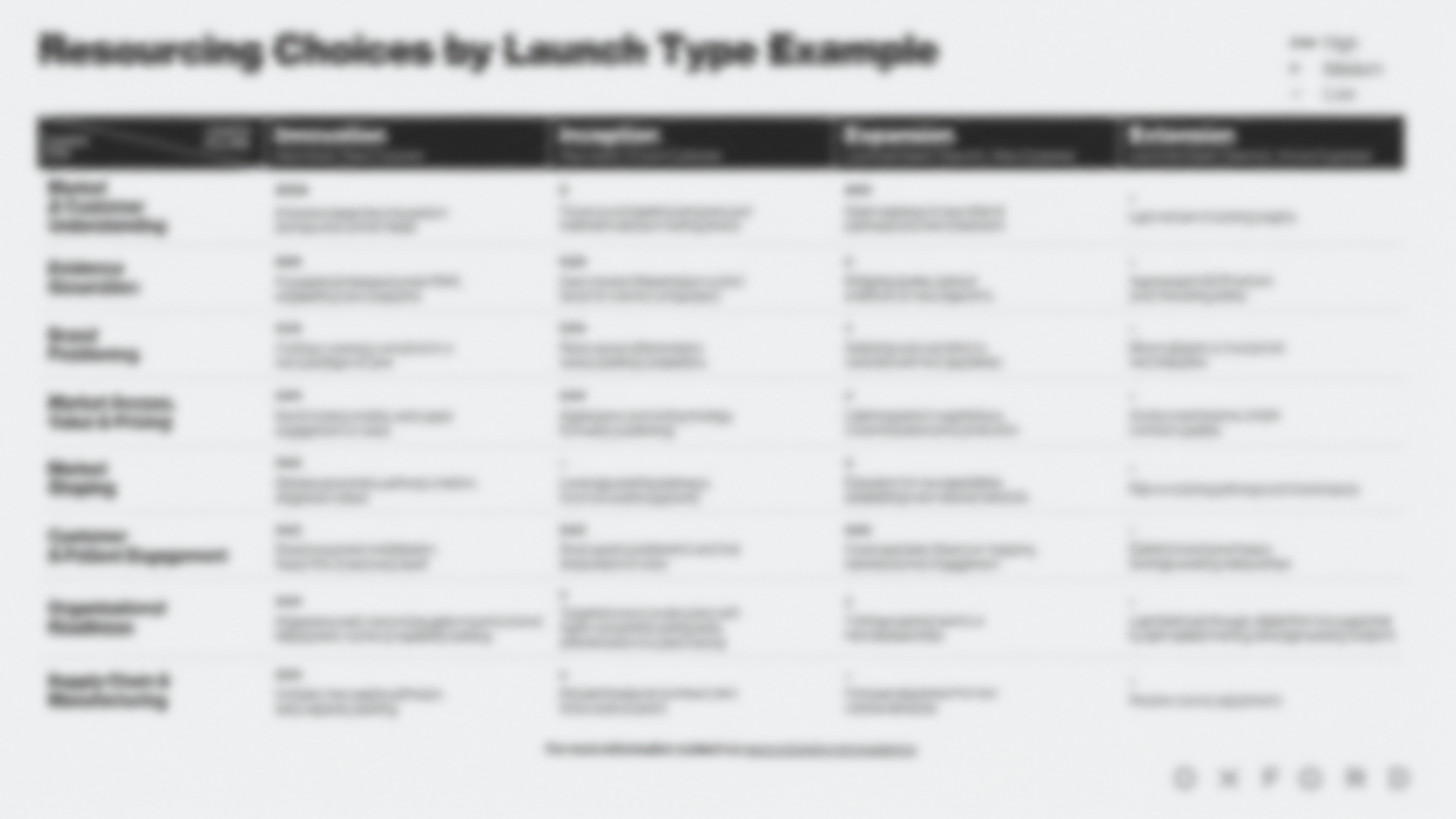
Using the launch framework with your team
A well‑designed Launch Framework ensures a common approach to launch. It gives structure and guidance for cross‑functional teams to tailor their launch by type, avoids duplication and leads to a single, focused plan.
In practice:
- Bring the cross‑functional team together around the framework and agree the launch type.
- Use the framework and drill down into the pillars and focus areas and ask: for this launch type, what really matters in evidence, access, market development, field pull‑through and capabilities?
- For each success factor, define the critical deliverables – the few “must‑haves” for this launch.
- Then outline the activities required to create those deliverables, consciously dialling them up or down based on launch type.
This turns the framework into a tailored launch roadmap expressed as one coherent cross‑functional story, not a stack of siloed functional plans. Global, country and functional teams use one language and toolset while still tailoring to risk/return and market context.
It also creates a shared view of what good looks like across C‑suite, GMs and functions. Leaders can see where the organisation is investing in high‑impact archetypes and simplifying lower‑return launches. Teams feel they have both structure and permission: structure to ensure the basics are covered, and permission to stop treating every launch in the same way.
Ultimately, the true value of the launch plan comes from teams working together, communicating effectively, and staying aligned on the same priorities—not from the document itself.
Read the other posts in our launch excellence series:
.png?width=1200&height=627&name=Scenario%20Planning%20(2).png)
Can we help you?
Delphine leads our Life Sciences team, reach out to her to talk about creating a launch plan that sticks.

Share this

When does launch really start?

Scenario planning for launch


No Comments Yet
Let us know what you think